When I first discovered OpenClaw, I was blown away by what a personal AI assistant could do. I saw the opportunity to bring that capability into the enterprise—and understood that it would need much stronger controls. That became the starting point for OpenClawMachines.
Four requirements shaped the platform
An enterprise agent needs infrastructure that a team can provision, govern, and operate. I built OpenClawMachines around four requirements:
Scalable compute
Capacity that can be provisioned easily as people and workloads are added.
Authentication and team management
A clear identity for every user, with access organized around teams and workspaces.
Isolation and secrets management
Separate execution environments and controlled handling of the credentials agents need.
Controlled access to external systems
Integrations with explicit permissions over which tools an agent can use and what those tools can do.
Putting those controls into practice
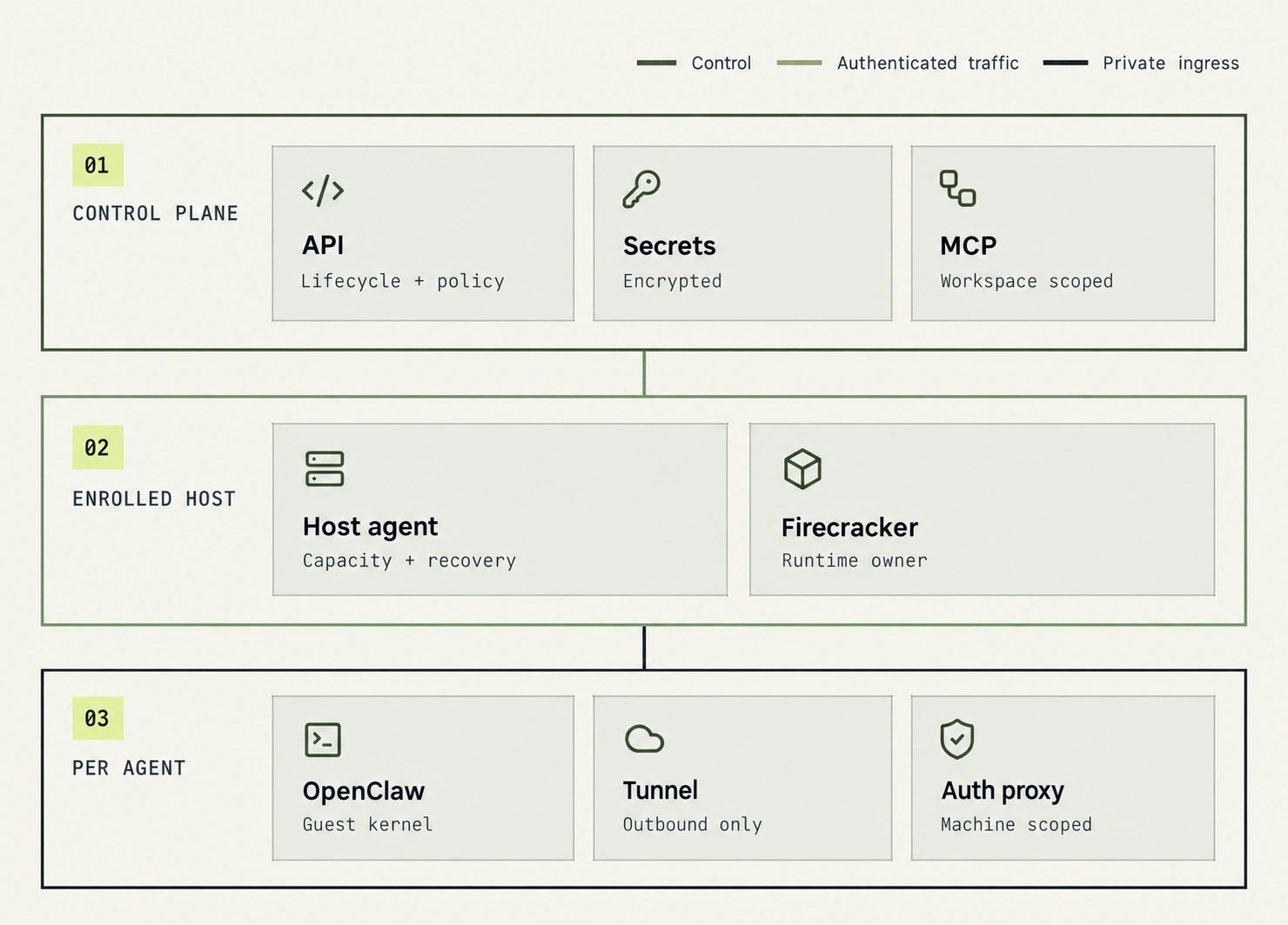
OpenClawMachines brings the control plane, compute, identity, and integrations into one operating model. Hosts provide capacity for dedicated Firecracker microVMs. Each agent gets its own execution boundary and persistent state. Authentication is checked at the edge and again at the machine, while secrets and model credentials are managed outside the agent’s everyday workspace.
Connect the tools. Keep control of the actions.
Workspace-scoped MCP integrations connect business systems to agents through reviewed tools. Administrators can allow an operation, require approval, or deny it. Browser environments, machine lifecycle controls, backups, logs, and usage visibility complete the operating picture: the team can manage the environment around an agent as well as the work it performs.
The building blocks have matured
The ecosystem now offers a growing set of products across the layers an enterprise agent platform needs. These are examples of the available building blocks, rather than a list of OpenClawMachines dependencies:
Agent runtimes and assistants
Hermes Agent, Amazon Quick, Claude Cowork, Codex, and NanoClaw.
Sandboxes
Daytona, Superserve, and E2B.
Integration platforms
Composio and Nango.
Browser automation
Browserbase.
Private networking
Cloudflare Tunnel and Tailscale.
The work is in bringing the pieces together
Choosing capable components is one part of the job. They still need to share a coherent model for identity, permissions, state, secrets, and operations. An organization needs to know which agent can reach which system, where its work runs, how a person intervenes, and how the environment recovers. Those connections turn a collection of products into a working platform.
A meta harness for the organization
I think of the result as a meta harness: an organization-level agent platform around the individual agents and their runtimes. It provides a shared foundation for workflows, integrations, knowledge, and operational controls. Its value compounds as teams add to it. A new workflow can reuse established connections and policies; new knowledge can support more than one agent; operating lessons can improve the whole platform.
An opinionated starting point
The right architecture will look different for every organization. OpenClawMachines is an opinionated, open-source reference implementation—a practical starting point for understanding the tradeoffs and building a platform around your own requirements. Explore the repository, try it, break it, and tell me what is missing.